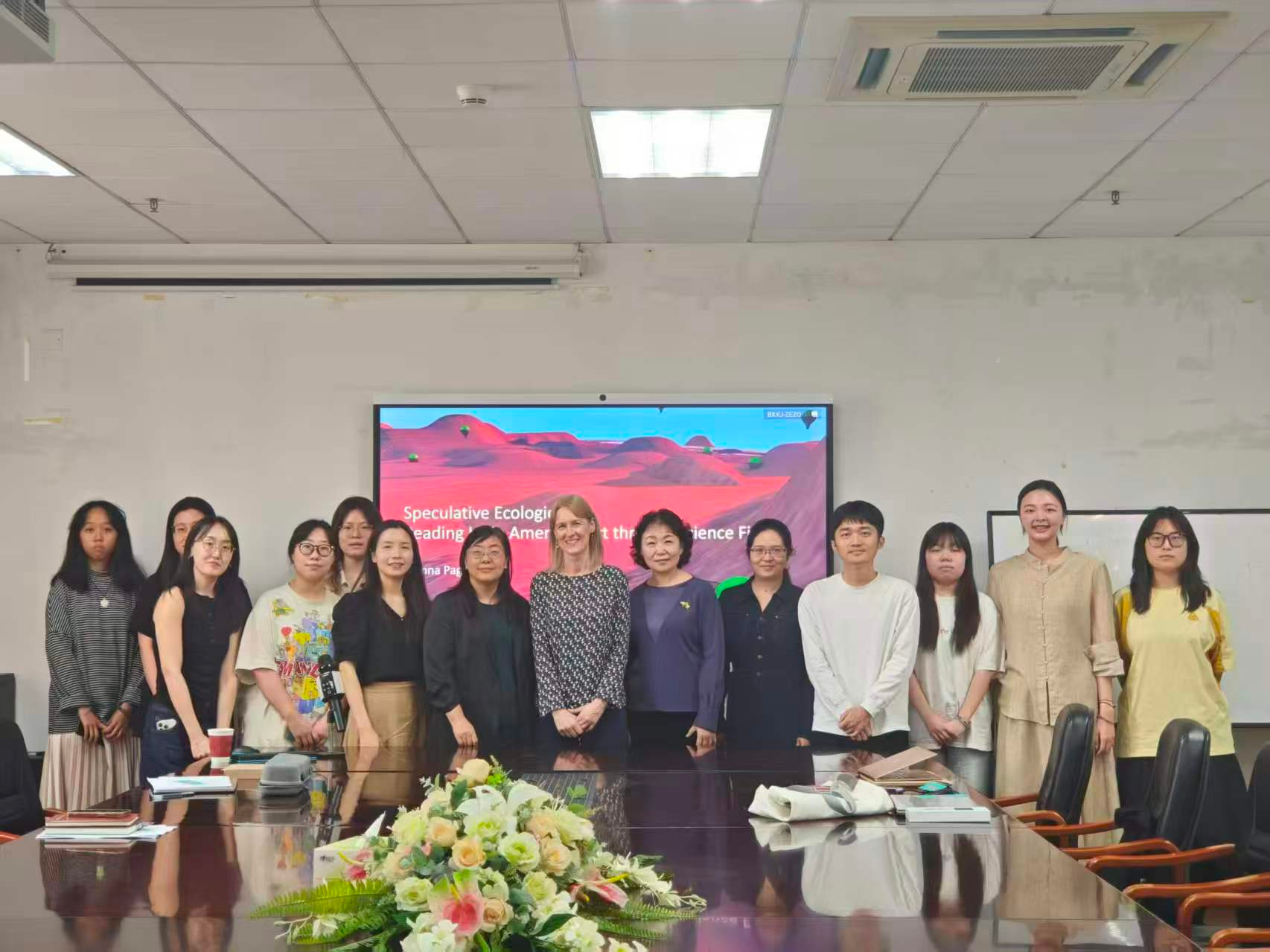
On the morning of April 7, Professor Joanna Page, Fellow of the British Academy and Director of the Centre for Research in the Arts, Social Sciences and Humanities (CRASSH) at the University of Cambridge, delivered a distinguished lecture titled “Speculative Ecologies: Reading Latin American Art Through Science Fiction” in the main conference room of the School of Humanities at Shenzhen University. The lecture was the 215th installment of Shenzhen University Lecture Series, the university’s highest-level comprehensive academic forum. Organized by the SZU Department of Social Sciences, the School of Humanities, and the Center for Digital Humanities, the event was hosted by Professor Jiang Yuqin, Director of the Center for Digital Humanities. Attendees included faculty and students from SZU’s School of Humanities, Faculty of Arts, Institute for Cultural Industries, as well as from institutions such as The Chinese University of Hong Kong.
Before the lecture, Professor Jiang Yuqin introduced Professor Joanna Page’s academic achievements and professional background, and on behalf of the Department of Social Sciences, presented her with an honorary certificate for the Shenzhen University Lecture Series.
Professor Page began by posing a series of thought-provoking questions: “What happens when science fiction appears not as narrative, but as a method of artistic practice? What does it mean for an artwork to function like science fiction? Does it point to world-building and the imagination of alternative ecologies?” From this starting point, she introduced five influential Latin American artists and their works, demonstrating how they employ science fiction perspectives to conduct “experiments” in ecological thought.
First, she discussed Argentine artist Tomás Saraceno, who engages in speculative architecture. For over a decade, Saraceno has designed aerial habitats powered solely by solar energy and air currents, proposing a future vision of the “Aerocene.” His works are not escapist fortresses but invitations for humans to coexist with natural forces like wind and atmosphere. Using discarded plastic bags to create collective hot-air balloons equipped with sensors to monitor meteorological changes, he transforms art into participatory public practice and challenges the notion that architecture must be grounded.
Another Argentine artist, Joaquín Fargas, uses irony to critique technological solutionism. His solar-powered robots slowly traverse Antarctic snowfields, compressing snow into ice to slow glacial melting, while his specially designed windmill cooling devices for the Antarctic subvert grand technological narratives through deliberately “clumsy” designs.
The Mexican collective Interspecifics turns to the invisible microbial world. They capture bioelectrical activity from bacteria and slime molds, translating these signals into audiovisual performances—effectively building a “communication translator” for microorganisms. This allows audiences to “hear” and “see” the activities of microscopic life, prompting reflection on non-human intelligence and communication.
Also from Mexico, Gilberto Esparza creates “nomadic plants”—robots powered by energy from microbes that break down toxins in polluted water. These devices autonomously seek out contaminated water to purify it while sustaining plants growing on their structures. Embracing a “slow robot” philosophy, Esparza’s work counters technological accelerationism by aligning technology with natural rhythms.
Brazilian artist Ivan Henriques has designed both symbiotic machines that clean algae from rivers and plant-sowing devices for Mars. Rather than glorifying interplanetary colonization, his works remind viewers that even on other planets, humans remain dependent on plants. By drawing parallels between red-polluted rivers after Brazilian mining disasters and the Martian landscape, Henriques highlights the contradiction between destroying Earth and fantasizing about escape.
In conclusion, Professor Page emphasized that Latin American ecological art insists that the future should not be designed on a blank slate but should emerge through negotiation with other life forms. These works demonstrate how science fiction aesthetics can serve as decolonial environmental thought, challenging hierarchies between nature and technology, human and non-human, and becoming laboratories for ecological thinking where alternative forms of coexistence can be tested or imagined. Moreover, these projects often employ DIY technology, open-source coding, and community workshops, treating technology as shared public knowledge—a reflection of the technical conditions and grassroots creativity of the Global South.
Following the lecture, Professor Jiang Yuqin praised Professor Page’s presentation, noting that it introduced, from a science fiction perspective, how Latin American visual artists respond to ecological crisis by merging macro and micro perspectives, technology and organic life, to reconfigure relationships between humans, non-humans, and nature. Professor Jiang also referenced posthuman theorists such as Rosi Braidotti and Katherine Hayles (“From Bacteria to AI”), stressing the importance of moving beyond anthropocentric frameworks.
During the Q&A session, lively discussions unfolded around four key themes:
1. Professor Page defined “speculative” as broader than related concepts in Haraway’s work, emphasizing responsible, ethical imagination oriented toward the future, with both representational and practical generative value.
2. She explained the regional distinctiveness of Latin American ecological art, rooted in decolonial contexts, characterized by critical reflection on technology, and emphasizing community participation and accessible practice.
3. On AI and ecological crisis, she suggested AI is not a solution but can help dismantle human-centered hierarchies of intelligence.
4. She proposed pathways for cultivating science fiction thinking, centered on breaking disciplinary boundaries and textual constraints through interdisciplinary practice.